


Overhead guard structural testing for lift trucks
20 March 2026

Occupational safety, especially in environments utilizing heavy machinery such as forklifts (or lift trucks), is a top priority. These vehicles are essential tools for material handling in warehouses and construction sites, yet they carry significant risks. To mitigate these hazards, international legislation and standards (such as ISO 6055 or EN 1551 specifications) mandate rigorous structural resistance tests, particularly for the operator’s protective structure, known as the overhead guard.
THE CRITICAL FUNCTION OF THE OVERHEAD GUARD
The overhead guard is not merely a component for weather protection, but a crucial safety element. Its primary function is to protect the operator from the risk of falling loads or materials during lifting and transport operations. Without this protection, even the fall of relatively light objects from significant heights can cause serious or fatal injuries.
The design and materials used for this component must ensure that, in the event of an accident, the structure is capable of absorbing impact energy without collapsing or deforming to such an extent that it crushes the operator inside the cabin.
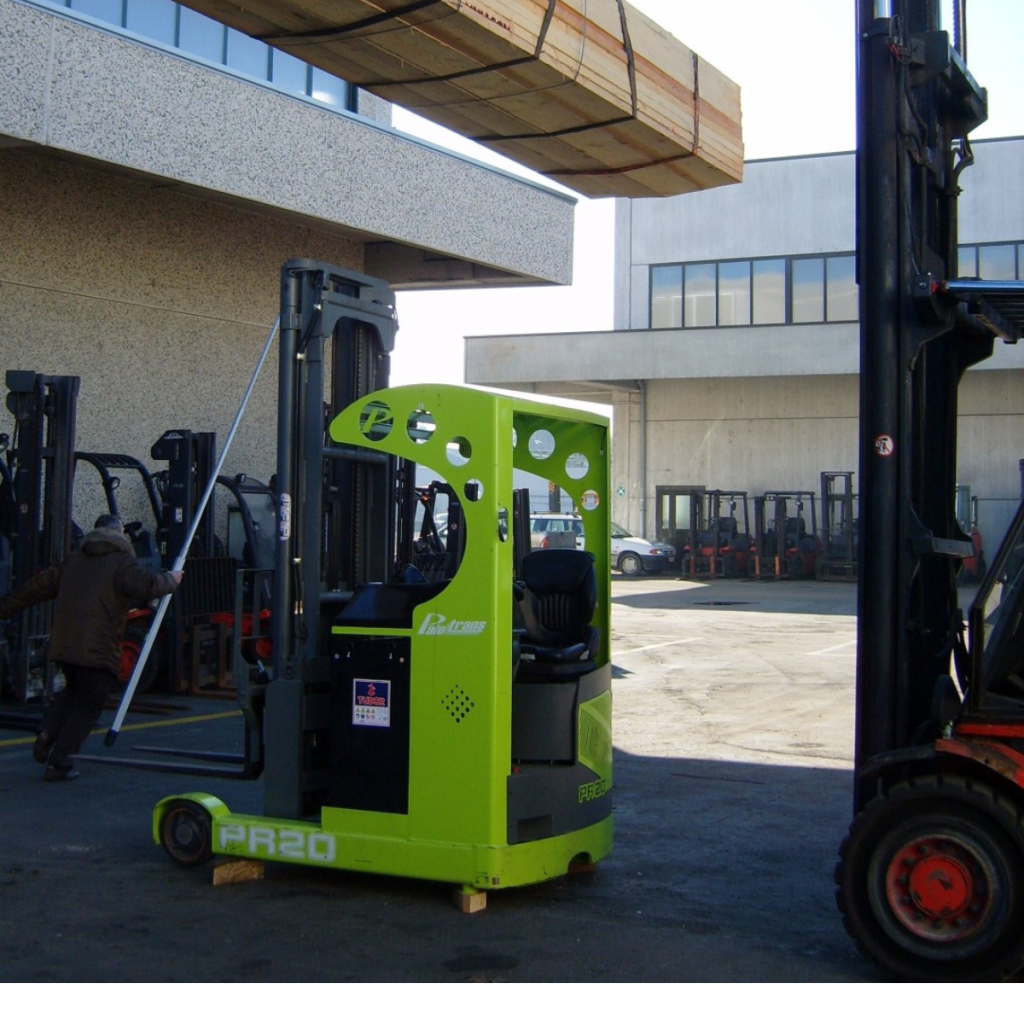
STRENGTH TESTING PROCEDURES AND STANDARDS
Overhead guard strength tests are conducted to simulate the most severe impact conditions. The objective is to verify the roof’s capacity to withstand a significant and concentrated load.
Structural Requirements: The structure must withstand the test without significant fracturing or failure.
Load Simulation: The test simulates the impact of a load that could accidentally fall from the mast, a high-level rack, or another forklift operating at a higher level. The load is not merely placed on the structure; instead, standards require that it be dropped from a specific height or that an equivalent static force be applied that exceeds the maximum weight the truck is rated to lift.
Deflection Measurement: During the test, technicians closely monitor any permanent deformation of the structure. The standard establishes precise deflection limits; the structure must not suffer any failure that encroaches upon the operator’s protective or clearance space, ensuring that the driver’s survival space remains intact.
MAINTENANCE AND COMPLIANCE
For a company, ensuring that forklifts consistently remain compliant with tests and regulations is essential—not only for safety but also to avoid legal penalties and operational downtime.
- Initial Certification: Every new forklift model must pass these tests during the design phase to obtain CE certification (in Europe) and type approval.
- Regular Inspections: Forklifts in service must undergo periodic inspections by qualified personnel. Any visible damage to the overhead guard, even if minimal (such as cracks, dents, or compromised welds), undermines its effectiveness and requires immediate withdrawal from service for repair or replacement.
- Training: Operators must be properly trained to ensure they always work safely.
THE VALUE OF CERTIFICATION: GUARANTEE OF SUITABILITY AND LEGAL PROTECTION
Relying on a Notified Body to conduct testing is the best guarantee of compliance. ECM, with its specialized technical staff and regularly calibrated instrumentation, performs testing in accordance with current regulations and issues an official test report. Entrusting ECM provides the employer with objective evidence of having rigorously fulfilled their prevention obligations, ensuring maximum operational safety and the full legal validity of the assessment.
We provide high-quality testing services for products, machinery, and equipment to ensure the highest possible level of workplace safety. Contact us for more information at info@entecerma.it